
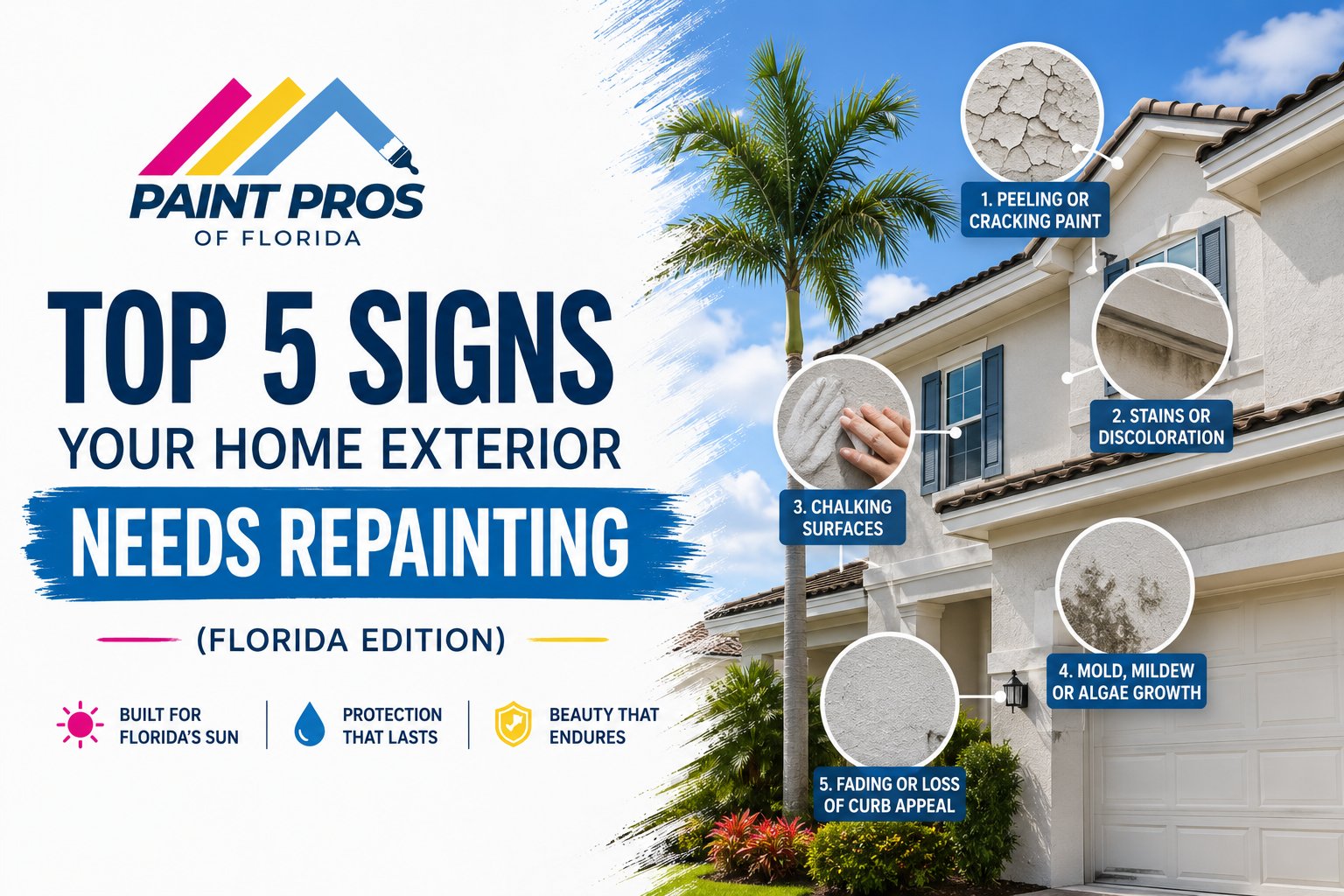

Most homeowners don’t think about repainting until something looks obviously wrong. In Central Florida, that’s usually too late. The same UV intensity, humidity, and afternoon rain cycles that make this state beautiful also accelerate every form of exterior paint failure — and what looks like a cosmetic issue on the surface is often a moisture or adhesion problem underneath. Here are the five signs Paint Pros of Florida looks for when we walk a property, and what each one is telling you about your home.
1. Fading and Chalking on South and West-Facing Walls
If your home’s color looks noticeably lighter on certain walls than others, that’s not uneven lighting — that’s UV degradation. In Florida, the sun arc combined with intense afternoon heat hits south and west-facing walls hardest. Over time, the pigment breaks down and the binder in the paint oxidizes, leaving a chalky residue that wipes off on your hand when you run it across the surface.
Chalking is the paint telling you its protective film is exhausted. Once that happens, the surface underneath — whether stucco, wood, or block — is taking direct weather exposure with every rain. A quick test: drag your finger across the wall. If it comes away with a powdery white film, you’re past due.
The fix isn’t just cosmetic. A proper repaint at this stage includes cleaning the chalk off completely before any new product goes on. Paint applied over chalking will fail prematurely regardless of the brand.
🔍 What to look for
Walls appear noticeably lighter or washed out on the south or west side of your home. When you drag a finger across the surface, a white powdery film transfers to your hand. The color difference between sun-exposed and shaded walls is visible from the street.
2. Peeling, Bubbling, or Flaking Paint
Peeling and bubbling are almost always moisture-driven. In Florida’s climate, water finds its way behind paint films through micro-cracks in caulk, failed sealant around windows and doors, or stucco that wasn’t properly primed before the last paint job. Once moisture gets behind the film, heat causes it to expand, and the paint lifts away from the substrate.
This is the sign that warrants the most urgency. Peeling paint isn’t just an eyesore — it means your substrate is exposed to repeated wet-dry cycles, which accelerates deterioration of the underlying stucco or wood. Left untreated, what starts as a peeling section near a window can become a stucco repair job within a season or two.
At Paint Pros of Florida, peeling always triggers a substrate inspection before we quote a repaint. If there’s moisture damage underneath, that gets addressed first. Painting over active moisture damage is the most common mistake contractors make — and the most expensive one for homeowners.
🔍 What to look for
Paint lifting away from the wall in sheets, curling at the edges, or forming raised bubbles — especially near window frames, door casings, or along the base of walls. Sections where the paint has flaked off entirely, exposing bare stucco or primer underneath.
3. Visible Cracks or Gaps in Caulk and Sealant
Walk the perimeter of your home and look at every point where two materials meet: window frames against stucco, door casings, utility penetrations, corner beads, and expansion joints. Caulk and sealant at these joints have a finite lifespan — typically 5 to 7 years in Florida’s climate — and when they fail, they open direct pathways for water intrusion.
Cracked, shrunken, or missing caulk is one of the most overlooked exterior maintenance issues in the region. Homeowners often notice the paint failure first — bubbling or staining near windows — without realizing the caulk joint failure is what caused it. By the time paint is failing near a joint, water has typically been getting in for months.
A proper repaint includes full caulk replacement at every joint before a drop of paint goes on the wall. If a contractor skips this step — or caulks over existing failed caulk without removing it — the new paint job will fail in the same spots within a year.
🔍 What to look for
Gaps, cracks, or shrunken lines of caulk where window frames and door casings meet the stucco wall. Caulk that has separated from one surface, leaving an open seam. Dark staining or paint bubbling directly adjacent to a window or door frame — a sign water has already been entering through a failed joint.
4. Mildew, Algae, or Dark Staining on Stucco
The dark streaks running down stucco from window sills, the green tinge along the base of walls near landscaping, the black spotting near the roofline — these are all biological growth, and they’re extremely common on Florida exteriors. The combination of humidity, warmth, and organic material creates ideal conditions for mildew and algae year-round.
Surface staining from biological growth is treatable — a proper wash and preparation process removes it before repainting. But if the growth has been present for an extended period, it can penetrate the paint film and bond to the substrate, which means cleaning alone won’t prevent it from returning. Sherwin-Williams Emerald Rain Refresh and Duration both carry built-in mildew-resistant additives that significantly slow regrowth compared to standard exterior paints.
If you’re seeing heavy biological staining across multiple surfaces, that’s a sign the current paint film has lost its protective properties. Repainting with a mildew-resistant product restores the barrier.
🔍 What to look for
Dark vertical streaks running down stucco from window sills or the roofline. Green or black discoloration along the base of walls, especially near landscaping or sprinkler zones. Spotted black growth on north-facing or shaded walls where moisture lingers longest after rain.
5. Your Last Paint Job Is 7 or More Years Old
In most of the country, a quality exterior paint job lasts 10 years or more. In Central Florida, plan for 7 to 10 depending on product quality, sun exposure, and how well the previous job was prepped. If your last exterior repaint was done with a builder-grade product — common on new construction and lower-bid repaint jobs — you may be looking at 5 to 6 years of real service life before protection starts to degrade.
Age alone doesn’t mean you need to repaint immediately, but it does mean you should be doing an annual walkaround and watching for the other four signs on this list. What typically happens is that a home hits year 6 or 7 and multiple issues surface at the same time: some chalking on the west wall, a small peeling section near a window, a few cracked caulk joints. Each issue is manageable on its own. Together they signal the system has run its course.
The cost of repainting before failure is always less than the cost of repainting after substrate damage has set in. If your home is approaching 7 years since the last paint job, a walkthrough with Paint Pros of Florida will tell you exactly where you stand — and what, if anything, needs attention now versus next season.
🔍 What to look for
Color that has lost depth or vibrancy compared to photos from when the home was painted. A combination of minor issues appearing simultaneously — slight chalking, one peeling spot, a cracked caulk joint — that individually seem small but together indicate the paint system has reached end of service life.
Exterior paint failure in Florida rarely happens all at once. It builds gradually, and the homeowners who catch it early spend less and protect more. If you’re seeing any of these signs on your home, a professional assessment costs you nothing and gives you a clear picture before small issues become expensive repairs.
Ready to Get a Professional Estimate?
Paint Pros of Florida serves Lakeland, Davenport, Kissimmee, Haines City, Clermont, Winter Haven, and surrounding Central Florida areas.
Or call us directly: (407) 326-0044